
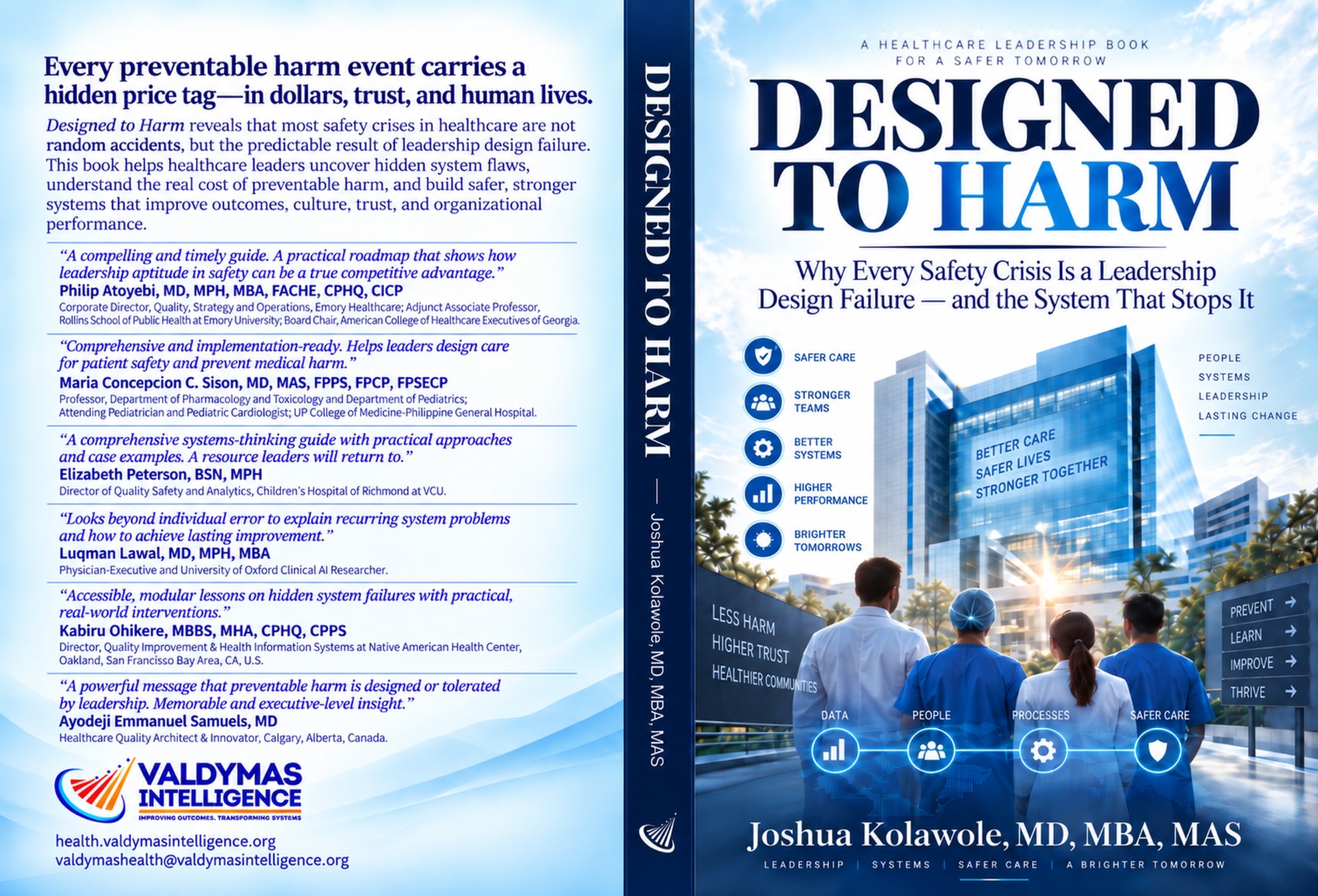


DESIGNED TO HARM
Why Every Safety Crisis Is a Leadership Design Failure—and the System That Stops It
There’s an uncomfortable truth hiding in plain sight across healthcare: a well-intentioned clinical team working exceptionally hard in fragmented silos will always be mistaken for a team with a clinical competence problem.
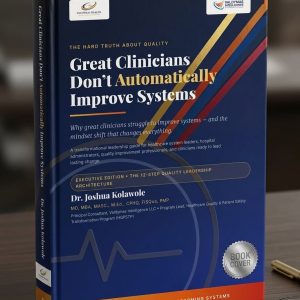
Frontline clinicians face exhausting ambiguity where sprawling policy binders bear little resemblance to a chaotic bedside reality. In Designed to Harm, Dr. Joshua Kolawole names what healthcare executives suspect but rarely trace: poor quality is a massive, hidden cost center sitting below the waterline, and running symbolic committees in isolation will never protect your patients or your margin.
Traditional healthcare management focuses on forming quality committees or chasing annual compliance surveys—mistaking a wall of certificates for true organizational safety. Dedicated leaders fund isolated initiatives that exhaust their staff, multiply duplicate workflows, and ultimately leave their clinical outcomes unchanged. Dr. Joshua Kolawole proves there is a more disciplined, integrated way forward.
Drawing on over two decades of global experience strengthening institutions at the point where medical care meets system performance, Kolawole reframes quality not as a peripheral department, but as an organization’s fundamental executive leadership operating system. He delivers a practical, resource-aware architecture designed to convert baseline diagnostics into visible, transferable, and scalable institutional performance.
Inside, you’ll learn how to:
- Diagnose Before You Design: Look beyond individual errors and examine the system around them by evaluating why traditional fixes fail and how to approach root causes systematically.
- Win the Executive Mandate: Position quality as a strategic investment with your Board and CFO, translating safety improvements into concrete financial returns to protect organizational margin.
- Connect Levels of Governance: Unify executive oversight with frontline clinical practice, bridging the dangerous gap between an administrator’s documentation and operational reality.
- Deploy a Systems Thinking Standard: Transition your culture from individual blame to systemic accountability, ensuring leaders design processes that make errors difficult to commit.
- Master Essential Executive Skills: Evaluate high-risk medication enterprise risks, navigate workforce crises, and audit organizational energy rather than just managing calendar time.
- Eliminate Meeting and Dashboard Fatigue: Overhaul broken quality dashboards that present data without insight, shifting from passive tracking to active, decision-focused choices.
- Build True Psychological Safety: Anchor your strategic assets in an open reporting culture that leverages near-misses and learning systems to prevent harm before it occurs.
- Verify Performance Over Documentation: Move past the “documentation theater” of compliance panic and build daily, sustainable operational habits that make survey readiness a continuous reality.
- Govern Digital and AI Disruption: Deploy strict accountability frameworks for implementing technology, governing medical algorithms, and mitigating cybersecurity safety threats.
- Run the PULSE Implementation Framework: Apply practical 60- to 90-day implementation roadmaps tailored across multi-system hospitals, clinics, home health, long-term care, and surgery centers.
- Sustain Quality as a Financial Strategy: Stop the financial drain of preventable complications and structural disconnects to achieve lasting value-based care optimization.



Reviews
There are no reviews yet.