
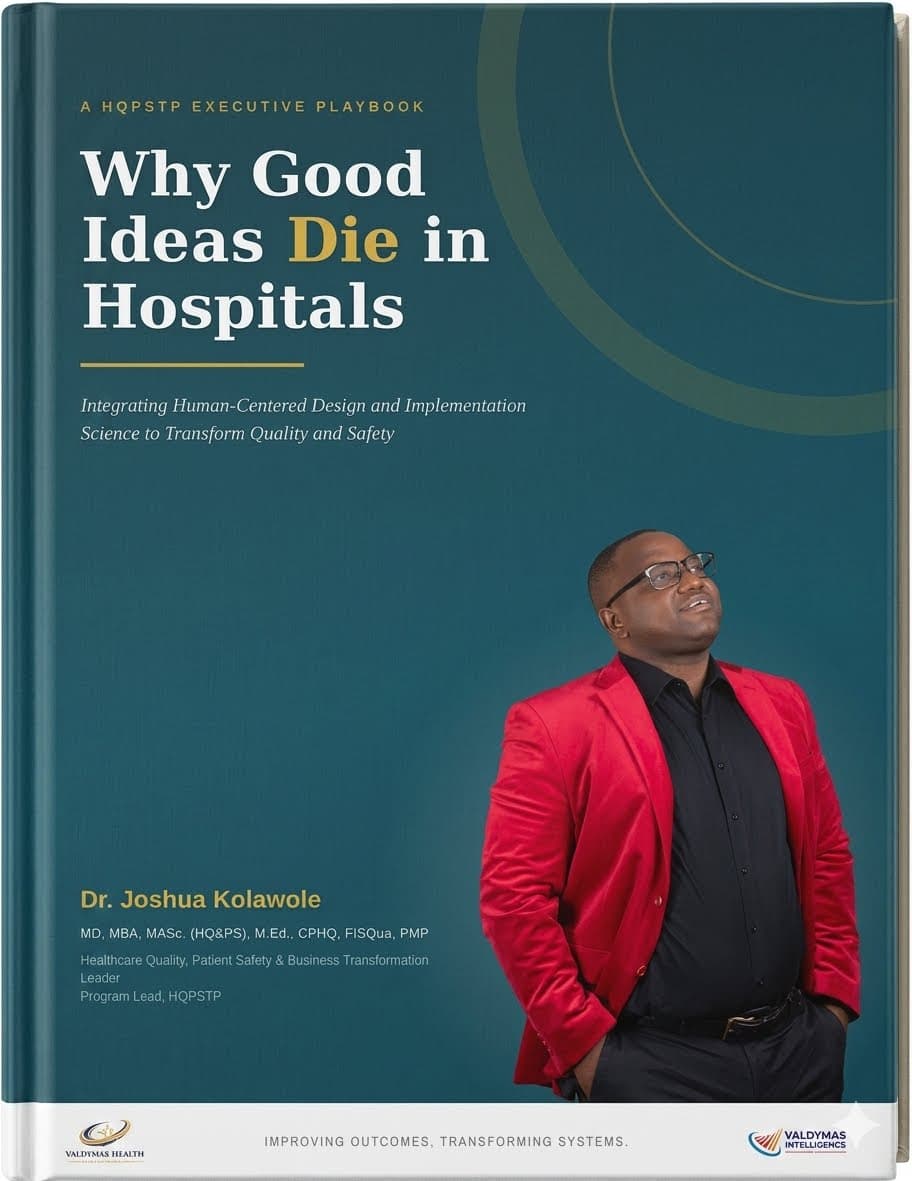

Why Good Ideas Die in Hospitals
The sepsis early-warning project had everything: a respected champion, solid evidence, a credible vendor, an approved budget, even cake at the launch town hall. Fourteen months later, a resident asked her attending what the yellow banner on the screen meant. “Ignore it,” he said, without looking up. “Everybody does.” Nobody killed the project. There was no memo, no funeral. It simply stopped being real—the way most good ideas in healthcare quietly die.
Roughly 70% of transformation and digital initiatives fail to deliver expected value—and the causes are almost never technical. Dr. Joshua Kolawole, a physician-executive with two decades leading quality transformation across hospitals, health plans, and health systems worldwide, argues that healthcare doesn’t have a knowledge gap. It has a knowing-doing gap. Proven practices can take up to seventeen years to become routine care, not because the evidence is weak, but because we design for approval instead of adoption and implement for launch instead of life.
This executive playbook fuses two disciplines healthcare has kept artificially separate: human-centered design, which ensures solutions are desirable and usable, and implementation science, which ensures they are adopted and sustained. Together they form the book’s flagship model, the D2I Bridge™—four phases spanning the chasm where 70% of good ideas fall: Discover & Diagnose, Co-Design/Prototype/Pilot, Implement & Adapt, and Measure/Scale/Sustain. Running beneath every phase is COVA—Choice, Ownership, Voice, and Authenticity—the behavioral current that transfers control to the frontline so teams don’t just comply with improvement; they ask for more of it.
Inside, you’ll learn how to:
- Name the Seven Fatal Patterns that kill initiatives—pilotitis, compliance theater, workaround culture, initiative overload, data without meaning, hero dependency, and leadership churn—without assigning blame
- Compute the full six-lens cost of failed change (clinical, operational, financial, regulatory, assessment, and leadership credibility) in numbers your CFO will trust
- Run Discovery Sprints, 90-minute co-design sessions, and PDSA pilots that turn skeptics into authors of the solution
- Survive the “messy middle” of implementation with champion teams, adaptation huddles, and a disciplined stop-list
- Engineer sustainment so results outlive their champions — and scale by copy-customize, never copy-paste
- Transfer real ownership to frontline teams with COVA, until quality improvement becomes something people pursue joyfully rather than endure
- Build your own Credibility Ledger, so every successful change compounds your standing with the board, medical staff, and regulators
Built around real case clinics—a $14M ED expansion averted by two weeks of listening, a sepsis bundle that survives differently at five hospitals, and a laboratory with the hospital’s worst morale that becomes its most requested model—this is not a theory book. Every chapter closes with named tools, a 30-day action plan, and the Leader’s Edge: what the discipline earns you in reduced risk, reduced chaos, and compounded credibility.


Reviews
There are no reviews yet.